CC-BY-SA 4.0
BMBFSFJ/Redaktion und Layout DLR-PT
CC-BY-SA 4.0
BMBFSFJ/Redaktion und Layout DLR-PT
CC-BY-SA 4.0
BMBFSFJ/Redaktion und Layout DLR-PT
CC-BY-SA 4.0
BMBFSFJ/Redaktion und Layout DLR-PT
CC-BY-SA 4.0
BMBFSFJ/Redaktion und Layout DLR-PT
CC-BY-SA 4.0
BMBFSFJ/Redaktion und Layout DLR-PT
CC-BY-SA 4.0
BMBFSFJ/Redaktion und Layout DLR-PT
CC-BY-SA 4.0
BMBFSFJ/Redaktion und Layout DLR-PT
CC-BY-SA 4.0
BMBFSFJ/Redaktion und Layout DLR-PT
CC-BY-SA 4.0
BMBFSFJ/Redaktion und Layout DLR-PT
Quellen:
Akçayır, G., & Akçayır, M. (2018). The flipped classroom: A review of its advantages and challenges. Computers & Education, 126, 334-345. https://doi.org/10.1016/j.compedu.2018.07.021
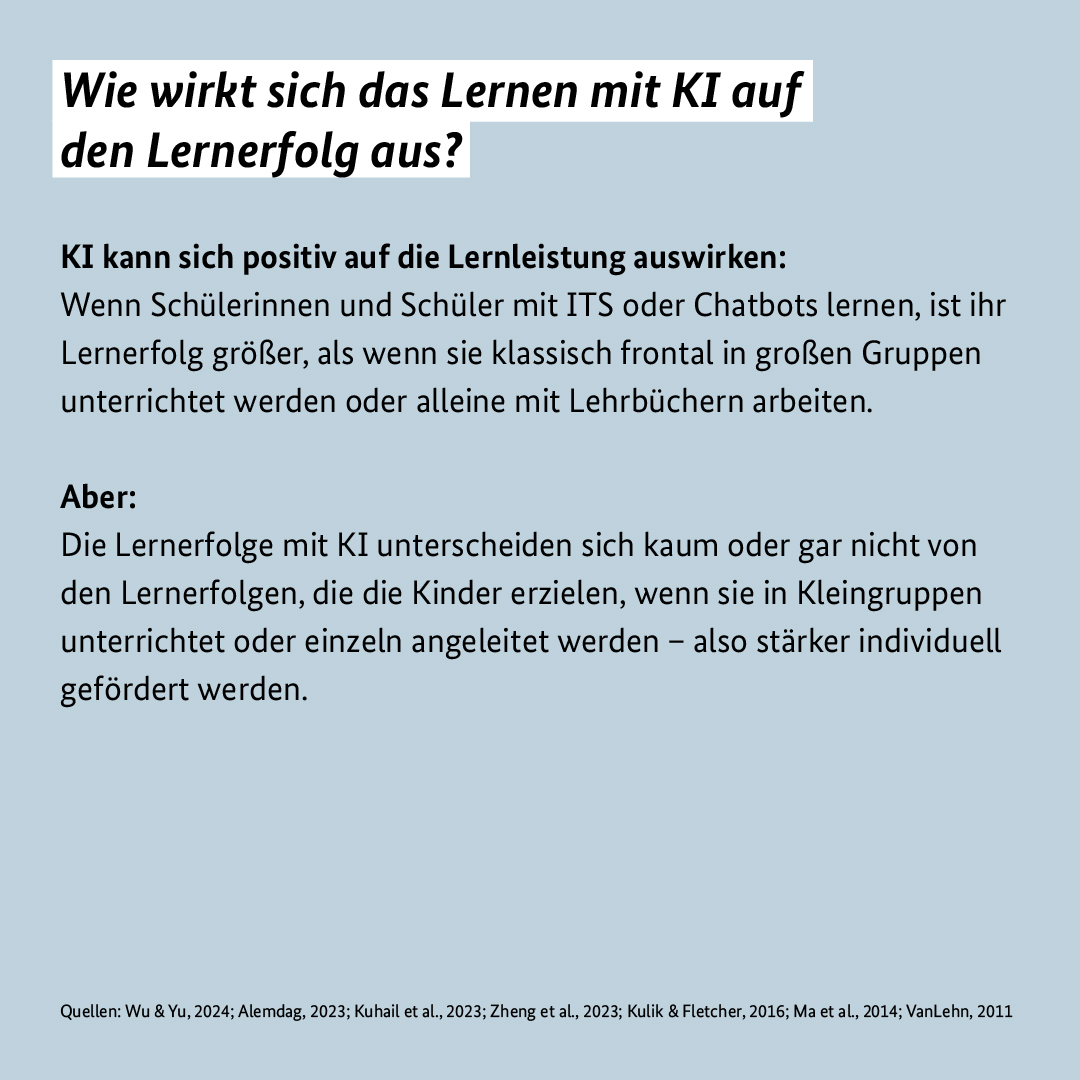
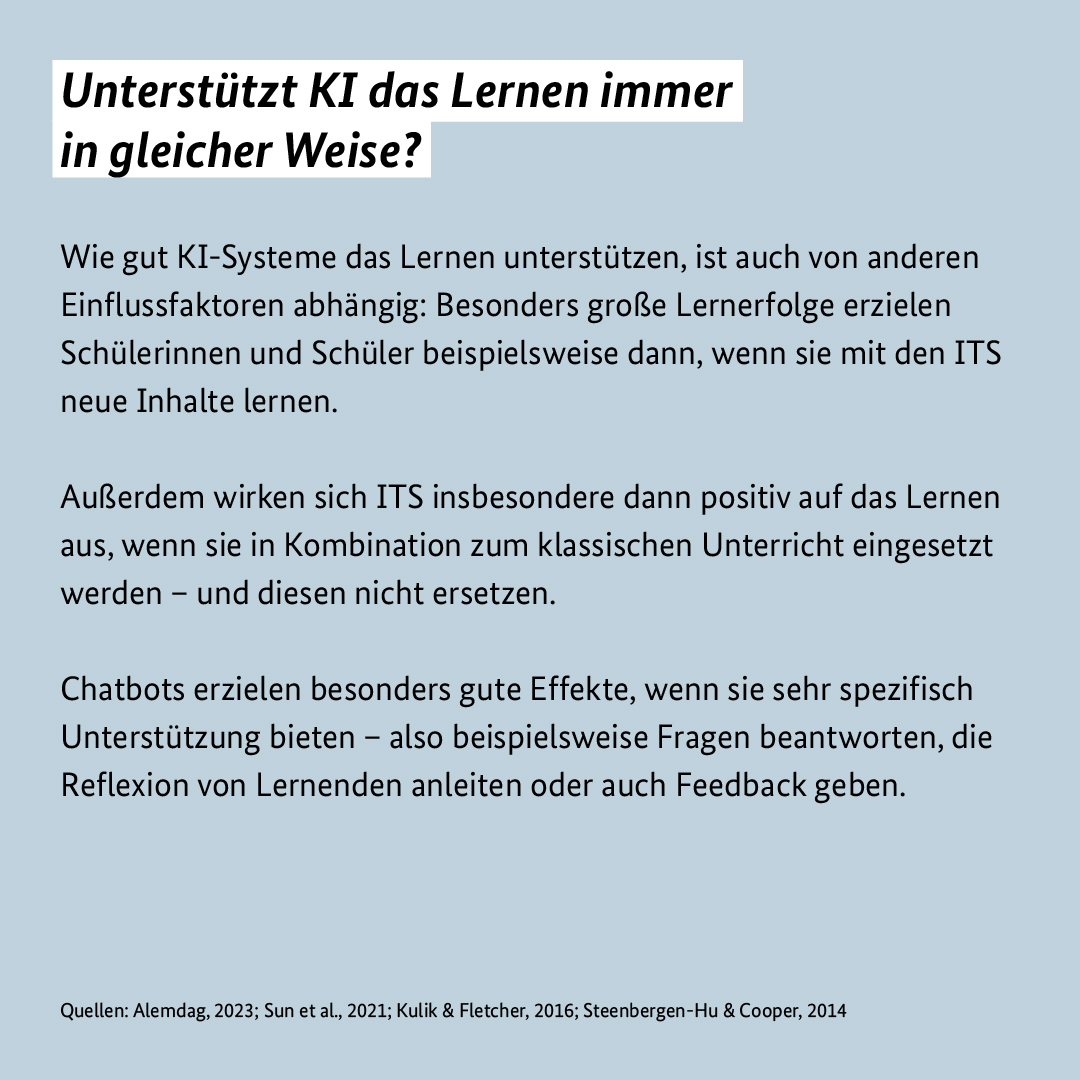
Alemdag, E. (2023). The effect of chatbots on learning: a meta-analysis of empirical research. Journal of Research on Technology in Education, 1-23. https://doi.org/10.1080/15391523.2023.2255698
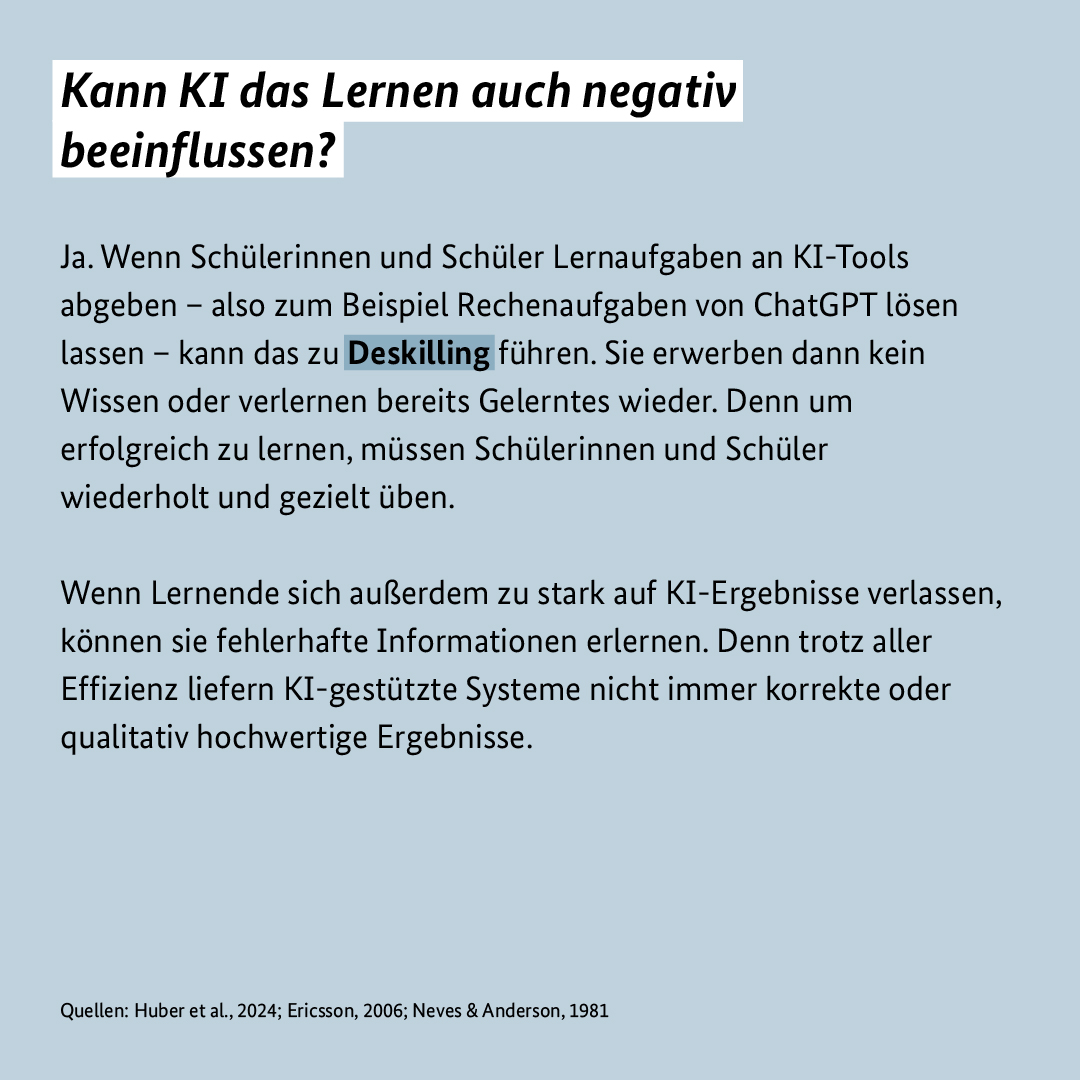
Ericsson, K. A. (2006). The influence of experience and deliberate practice on the development of superior expert performance. The Cambridge handbook of expertise and expert performance, 38(685-705), 2-2.
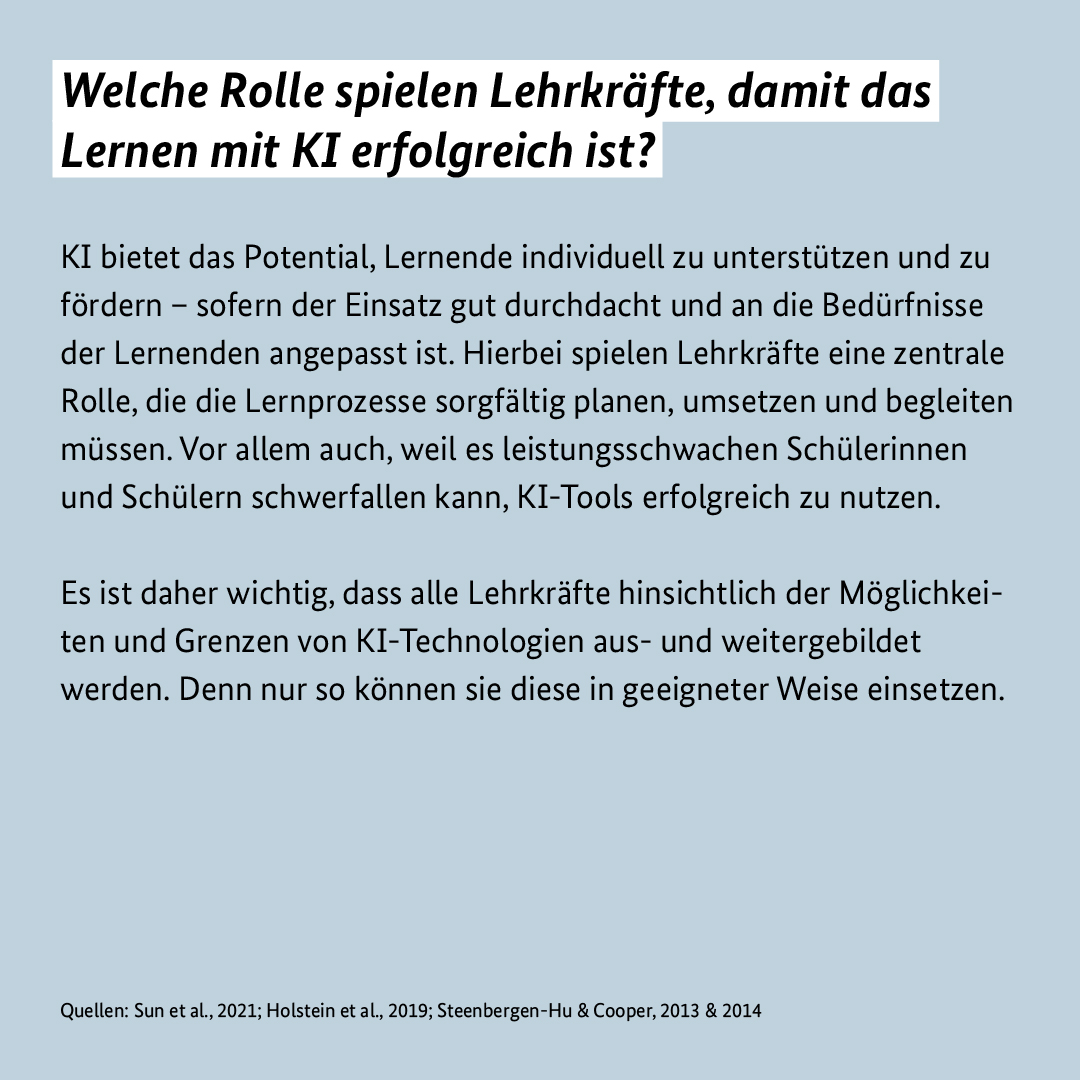
Holstein, K., McLaren, B. M., & Aleven, V. (2019). Designing for complementarity: Teacher and student needs for orchestration support in AI-enhanced classrooms. In S. Isotani, E. Millán, A. Ogan, P. Hastings, B. McLaren, & R. Luckin (Eds.) Artificial Intelligence in Education: 20th International Conference, AIED 2019, Chicago, IL, USA, June 25-29, 2019, Proceedings, Part I 20 (pp. 157-171). Springer International Publishing. https://doi.org/10.1007/978-3-030-23204-7_14
Huber, S. E., Kiili, K., Nebel, S., et al. (2024). Leveraging the Potential of Large Language Models in Education Through Playful and Game-Based Learning. Educational Psychology Review, 36(1), 1-20. https://doi.org/10.1007/s10648-024-09868-z
Kuhail, M.A., Alturki, N., Alramlawi, S. & Alhejori, K. (2023). Interacting with educational chatbots: A systematic review. Education and Information Technologies, 28, 973–1018. https://doi.org/10.1007/s10639-022-11177-3
Kulik, J. A., & Fletcher, J. (2016). Effectiveness of intelligent tutoring systems: A meta-analytic review. Review of Educational Research, 86(1), 42–78. https://doi.org/10.3102/0034654315581420
Ma, W., Adesope, O. O., Nesbit, J. C., & Liu, Q. (2014). Intelligent tutoring systems and learning outcomes: A meta-analysis. Journal of Educational Psychology, 106(4), 901–918. https://doi.org/10.1037/a0037123
Neves, D. M., & Anderson, J. R. (1981). Knowledge compilation: Mechanisms for the automatization of cognitive skills. In J. R. Anderson (Ed.), Cognitive skills and their acquisition (pp. 57-84). Psychology Press.
Ng, D. T. K., Leung, J. K. L., Chu, S. K. W., & Qiao, M. S. (2021). Conceptualizing AI literacy: An exploratory review. Computers and Education: Artificial Intelligence, 2, Article 100041. https://doi.org/10.1016/j.caeai.2021.100041
Steenbergen-Hu, S., & Cooper, H. (2013). A meta-analysis of the effectiveness of intelligent tutoring systems on K–12 students’ mathematical learning. Journal of educational psychology, 105(4), 970. https://doi.org/10.1037/a0032447
Steenbergen-Hu, S., & Cooper, H. (2014). A meta-analysis of the effectiveness of intelligent tutoring systems on college students’ academic learning. Journal of educational psychology, 106(2), 331. https://doi.org/10.1037/a0034752
Sun, S., Else-Quest, N. M., Hodges, L. C., French, A. M., & Dowling, R. (2021). The effects of ALEKS on mathematics learning in K-12 and higher education: A meta-analysis. Investigations in Mathematics Learning, 13(3), 182-196. https://doi.org/10.1080/19477503.2021.1926194
VanLehn, K. (2011). The relative effectiveness of human tutoring, intelligent tutoring systems, and other tutoring systems. Educational Psychologist, 46(4), 197–221. https://doi.org/10.1080/00461520.2011.611369
Wu, R., & Yu, Z. (2024). Do AI chatbots improve students learning outcomes? Evidence from a meta‐analysis. British Journal of Educational Technology, 55(1), 10-33. https://doi.org/10.1111/bjet.13334
Zheng, L., Niu, J., Zhong, L., & Gyasi, J. F. (2023). The effectiveness of artificial intelligence on learning achievement and learning perception: A meta-analysis. Interactive Learning Environments, 31(9), 5650-5664. https://doi.org/10.1080/10494820.2021.2015693
